
High-Grade Potassium Feldspar
Delivering performance, stability, and superior glaze results.
Potassium Feldspar, often referred to as K-Feldspar, is one of the most abundant and essential mineral groups in the Earth’s crust. Rich in potassium oxide (K₂O), it is primarily derived from minerals such as orthoclase, microcline, and sanidine. Known for its excellent fluxing properties, potassium feldspar plays a crucial role in a wide range of industrial applications, particularly in ceramics, glass, glazing, and enamel production.
Because of its ability to influence melting behavior, vitrification, and finish quality, potassium feldspar is considered a key ingredient in processes that demand precision and high performance. Its high alumina and alkali content also contribute to improved strength, hardness, and chemical resistance of the final product. In the glass industry, it helps enhance transparency and structural integrity. The mineral’s consistent composition makes it ideal for large-scale manufacturing where uniformity and reliability are essential. With its versatile characteristics, potassium feldspar continues to remain a cornerstone material across multiple industrial sectors.
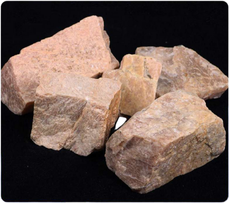
Minimum Order Quantity: 20 Metric Tons
Supply Capacity: 100 Metric Tons / Day
Packing Options: Loose / 25–50 kg bags / 1-ton jumbo bags
Form Available: Lumps, Chips, Grains, Fine Powder
Applications & Advantages
Ceramics Industry
Used extensively in porcelain, tiles, sanitary ware, and tableware.
Enhances plasticity of body composition.
Improves strength and durability of fired products.
Contributes to smooth surface finish and consistent glaze quality.
Helps in achieving whiter firing results when processed correctly.
Glass Manufacturing
Acts as an excellent flux in glass production.
Provides high clarity, improved thermal shock resistance, and enhanced transparency.
Its high alkali content aids in stabilizing glass composition and reducing production cost by lowering furnace temperatures.
Enamel & Glaze Formulations
Improves adhesion, smoothness, and finish of enamel coatings.
Helps achieve uniform melting and spreading of glazes.
Other Industrial Uses
Used in abrasives, adhesives, fillers, and fluxing agents for various industrial applications.
Functions as a stabilizer in chemical processes where consistent heat performance is required.
Chemical Properties
| Contents | S1 (%) | S2 (%) |
|---|---|---|
| SiO2 | 66.5 - 71.5 | 72.0 75.0 |
| Al2O3 | 18.3 - 20.6 | 14.0 16.5 |
| TiO2 | 0.05 - 0.10 | 0.20 - 0.30 |
| CaO | 0.14 - 0.84 | 0.30 - 0.40 |
| MgO | 0.10 - 0.15 | 0.09 - 0.12 |
| K2O | 0.34 0.44 | 0.10 - 0.20 |
| Na2O | 9.50 - 11.60 | 8.00 - 9.50 |
| Fe2O3 | 0.07 - 0.14 | 0.12- 0.30 |
| L.O.I. (Loss on Ignition) | 0.15 - 0.85 | 0.50 - 0.70 |
| Fired Colour @ 1220°C | Glossy / Clean Melt | Creamy / Yellowish Melt with Dirty Patches |